


What is a knee replacement?
A knee replacement (also called total knee replacement) is a surgical procedure where the diseased and arthritic surfaces of the bones are replaced with a prosthesis.
There are four main steps to a knee replacement procedure:
- Prepare the bone. The damaged cartilage surfaces at the ends of the femur and tibia are removed along with a small amount of underlying bone.
- Position the metal implants. The removed cartilage and bone is replaced with metal components that recreate the surface of the joint.
- Resurface the patella if required. The under-surface of the patella (kneecap) is cut and resurfaced with a plastic button
- Insert a spacer. A polyethylene (medical-grade plastic) spacer is inserted between the metal components to create a smooth gliding surface.
Do I need a knee replacement?
If you have knee arthritis that is substantially affecting your daily life due to pain and disability, then you should consider surgery.
People who benefit from total knee replacement often have:
- Severe knee pain or stiffness that limits everyday activities, including walking, climbing stairs, and getting in and out of chairs. It may be hard to walk more than a few blocks without significant pain and it may be necessary to use a stick or walker
- Moderate or severe knee pain while resting, either day or night
- Chronic knee inflammation and swelling that does not improve with rest or medications
- Knee deformity — a bowing in or out of the knee
- Failure to substantially improve with non-operative treatments
Why personalised knee replacement?
Personalised knee replacement gives each patient a bespoke knee operation matched to their native anatomy.
Although knee replacement is considered to be an effective intervention, historically many patients did not experience natural joints. It is reported that up to 20% of patients are dissatisfied. Instrument precision was poor, and implantation errors were frequent when knee replacement surgery was first introduced. The focus was therefore on implant survivorship rather than reproducing normal knee anatomy and function. To simplify operations, surgeons selected the same cuts for all patients. Individual patient anatomy was not reproduced, with the focus on standardisation of the procedure. These historical techniques are still used by most surgeons. Enhancements in our understanding of knee anatomy and biomechanics have suggested ways of improving knee replacement outcomes.
I have been researching how to improve outcomes from knee replacements for many years and have published numerous articles on the subject. More precise surgical techniques with navigation, patient-matched instrumentation and robotics allow the joint replacement to be matched to the patient’s anatomy. Aligning the knee with your normal anatomy, replicates your knee’s normal kinematics, resulting in you walking more naturally and has demonstrated improved functional outcomes.
The aim of my knee replacement is to produce a more natural knee joint, with resultant improved patient satisfaction and ultimately a forgotten joint.
What is robotic knee replacement?
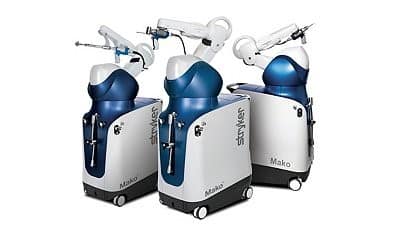
A surgical robot can assist in accurate implant positioning. It is a semi-active robot, which aids the surgeon in performing accurate bony cuts for knee replacement. The surgeon is physically in charge and controls the robot while cutting.
Robotic surgery builds on the advantages of computer navigation for knee replacement. Multiple studies have demonstrated that computer navigation produces more accurate prosthesis implantation than conventional instrumentation. It has also been shown to reduce the failure rate of knee replacements in patients under 65 years of age.
Robotic-arms for knee replacement surgery
How long will a knee replacement last?
Most patients should expect 20-30 years of life from their knee replacement. Looking at data from the Australian Joint registry: at 15 years 95% of implants are still functioning and at 20 years 90% are still functioning.
For more information about Personalised Knee Joint Replacement ask Dr Will Blakeney.
Surgery For Shoulder, Hip and Knee
Hip Surgery
Personalised Hip ReplacementConditions For Shoulder, Hip and Knee
Hip Conditions
Hip ArthritisEnquiry
WA Orthopaedic Consulting Rooms
Perth
St John of God
Medical Clinic
Suite 213
25 McCourt Street,
Subiaco WA 6008
Albany
Great Southern
Specialist Centre,
55 Cockburn Rd ,
Mira Mar WA 6330
Phone: 08 9489 8733
Email: blakeney@wcortho.com.au
Fax: 08 9489 8735
Perth Orthopaedic Operating Theatres
St John of God Hospital
12 Salvado Rd, Subiaco WA 6008